
Last updated October 16, 2026
 AC repair
 Furnace & heating
 Heat pumps
 Ductless mini splits
 Carrier
 Trane
Trane Goodman
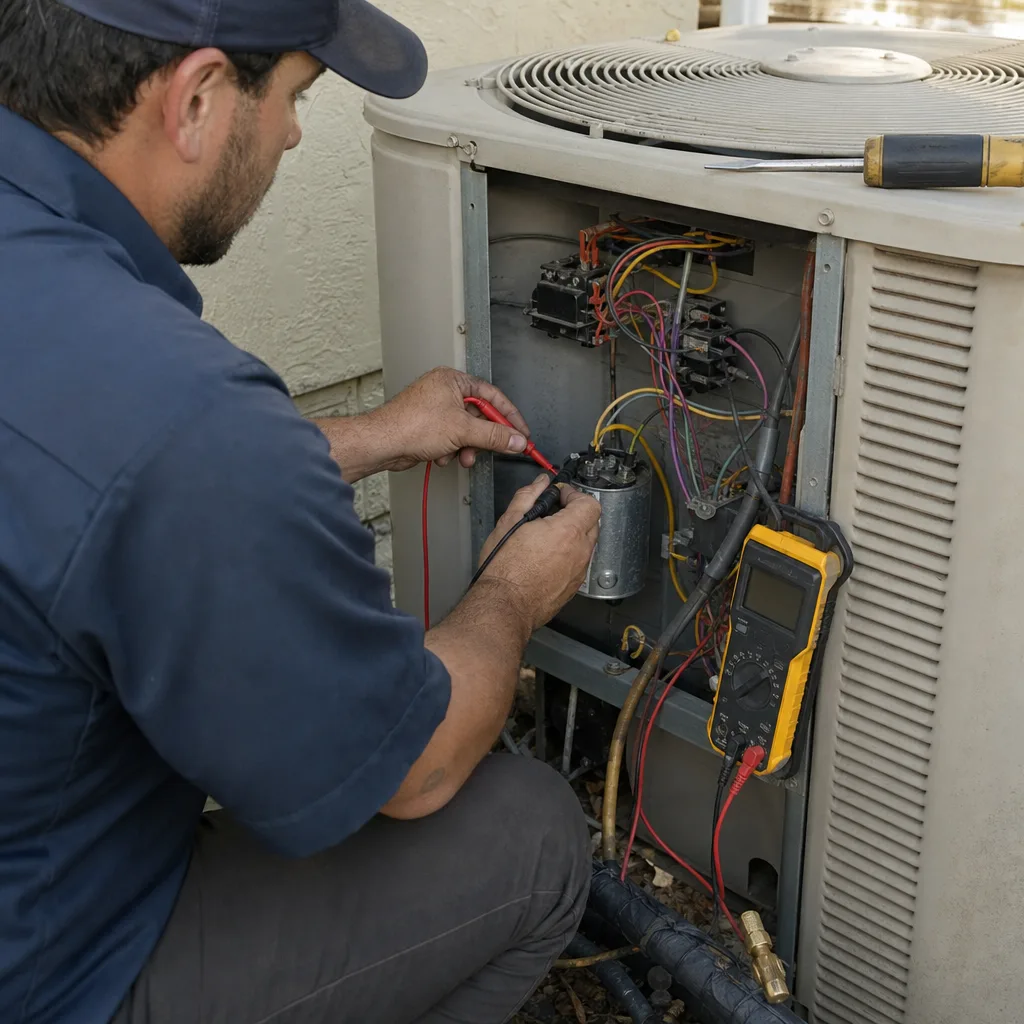
Seasonal tune-up and full diagnostic on your Carrier, Trane, or Goodman system - readings shown to you before any repair is proposed
Diagnosis first, numbers second - you approve the repair price before a single part goes in.
Get your free estimateDIY vs Professional HVAC: The Miami Homeowner’s Decision Guide
Handling refrigerant without an EPA 608 certification is a federal violation carrying fines up to $44,539 per day, yet “how to add refrigerant to home AC” gets tens of thousands of searches every summer. In Miami, where low refrigerant is one of the most common AC complaints, this is the first legal line most DIY guides don’t draw clearly. This guide gives you a straight answer to what you can legally and safely do yourself, what you should never touch, and where the money really goes when a DIY repair goes sideways in Miami’s climate. We’ll walk through the actual Florida statutes, the insurance fine print, the warranty language, and the honest cost of both paths.
Styles & brands we work with
Quick Answer
In Miami, the DIY versus professional HVAC decision starts with Florida law, not skill level. Any task involving refrigerant, electrical disconnects, or permitted system replacement is illegal for an unlicensed homeowner to perform, full stop. What’s left for DIY is narrow but real: filter changes, condensate drain flushes, thermostat battery swaps, and basic coil cleaning are all legal, safe, and worth doing yourself. For everything else, a licensed Miami HVAC technician is not just the safer choice, it’s the only legal one.
Table of Contents
- The Legal Boundary: What Florida Law Actually Prohibits
- The Genuine DIY Tasks: What You Can Safely Do in Miami
- How a DIY Repair Can Void Your Manufacturer Warranty
- The Hidden Cost of a Failed DIY Repair in Miami
- Symptom Decision Table: DIY or Call a Tech
- Miami Climate Considerations: Why Our Weather Changes the Math
- Insurance Consequences: What Your Policy Actually Says
- Common Mistakes to Avoid
- When to Call a Professional
- Frequently Asked Questions
- The Bottom Line
The Legal Boundary: What Florida Law Actually Prohibits
Florida Statute 489.103 is the line in the sand. It says, in plain terms, that any person who performs contracting work, including HVAC work, without the required license is engaging in unlicensed contracting. For HVAC specifically, Florida law requires a state-issued contractor’s license for any work that involves installing, repairing, altering, or maintaining an air conditioning system. The state does not carve out an exception for a homeowner working on their own system the way it does for some other trades. This is not a gray area, it’s a statute that has been enforced in Miami-Dade County repeatedly over the years.
The federal layer sits on top of that. The EPA, under Section 608 of the Clean Air Act, requires anyone who handles refrigerant to hold an EPA 608 certification. That includes adding refrigerant, recovering refrigerant, or even opening a refrigerant line to check pressure. The current fine structure allows penalties of up to $44,539 per day per violation. In Miami, where an undercharged AC is a daily reality from April through October, this rule catches more homeowners than any other single provision.
Here’s the specific list of what an unlicensed Miami homeowner legally cannot do:
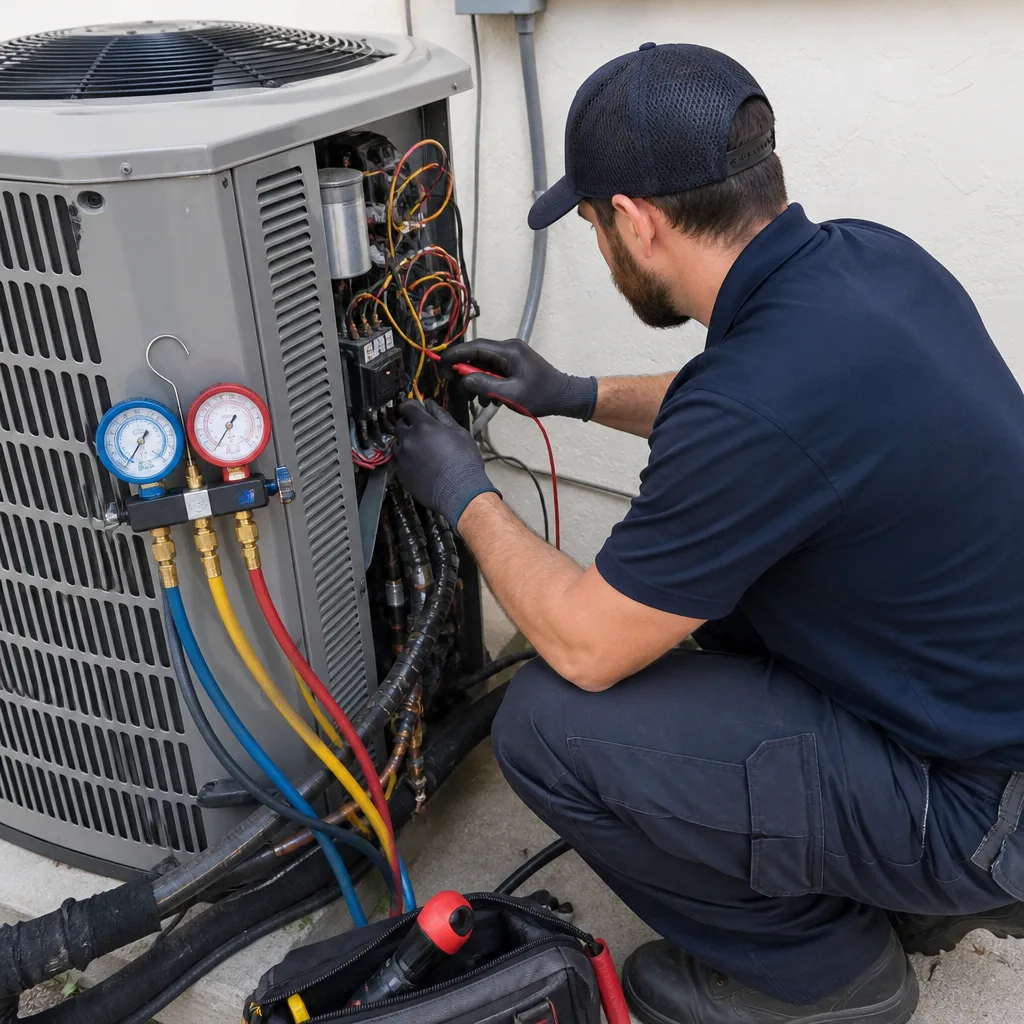
- Handle refrigerant in any form. Adding it, recovering it, checking it with a manifold gauge set, or even opening a service valve on a line set. All of it requires an EPA 608 certification, which requires passing a proctored exam, not watching a YouTube tutorial.
- Replace a condenser, air handler, or any component that requires a permit. Miami-Dade County requires a mechanical permit for most system replacements and major component swaps. Permits can only be pulled by a licensed contractor or, in limited cases, by the homeowner acting as an owner-builder. The owner-builder path requires you to occupy the home and still triggers inspection requirements that most homeowners are not prepared to navigate.
- Touch the electrical disconnect or run new electrical to an HVAC system. This falls under electrical contracting work, which requires a separate electrical license in Florida. Wiring a new condenser, replacing a disconnect box, or adding a circuit for a heat pump is illegal without that license.
- Modify ductwork beyond a simple register adjustment. Redesigning, replacing, or significantly altering duct runs often requires a mechanical permit and licensed work in Miami-Dade.
- Recover refrigerant from a system that is being decommissioned. You cannot legally cut a line set and let the refrigerant vent to atmosphere. Recovery requires certified equipment and a certified person.
What does this leave? The genuinely DIY tasks fall into a bracket that requires no license, no permit, and no special certification. Those are covered in the next section. And if you’re reading this and realizing the project you had in mind is on the illegal list, you already have your answer. We handle AC repair in Miami for homeowners who hit exactly this wall, and the first thing we tell them is what we just told you: the law draws a line, and it’s not a line worth crossing.
The Genuine DIY Tasks: What You Can Safely Do in Miami
There is a legitimate DIY lane for Miami homeowners, and staying in it will save you real money without putting you on the wrong side of a statute or a manufacturer’s warranty claim. These tasks require no license, no permit, and no special tools beyond what a typical Miami household already owns or can buy for under $30 at any hardware store in Kendall or Hialeah. The key is knowing exactly what these tasks accomplish and, honestly, what they don’t.
1. Air Filter Replacement
This is the highest-value DIY task in Miami, and the interval matters more here than almost anywhere else in the country. Miami’s dry season, from roughly November through April, carries fine dust and pollen through the air in volumes that clog filters faster than most national guidance accounts for. A standard 1-inch fiberglass filter that might go 90 days in Ohio will often be choked in 30 days in a Miami neighborhood like Westchester or Coral Gables when the dry season is in full swing.
Here’s the step-by-step:
- Locate the filter slot. It’s almost always in the return air grille on a wall or ceiling, or in a slot on the side of the air handler.
- Note the arrow on the filter frame. The arrow points in the direction of airflow, which is toward the blower and away from the return grille.
- Slide the old filter out and check the MERV rating printed on the frame. Buy a replacement with the same MERV rating, not a higher one. A MERV 13 filter in a system designed for MERV 8 will restrict airflow and can cause evaporator coil freeze in Miami’s humid air.
- Slide the new filter in, arrow facing the correct direction, and write the date on the filter frame with a permanent marker.
During Miami’s wet season, check the filter monthly. The combination of high humidity and constant AC runtime means filters load up faster than any national chart predicts. A clogged filter is also the single most common cause of the “AC running but not cooling” complaint we hear across Miami from June through September.
2. Condensate Drain Flushing
Miami’s humidity produces gallons of condensate every day, and the drain line that carries it away is a magnet for algae and sludge buildup. A clogged drain triggers a float switch that shuts the AC off entirely, which is a frustrating and entirely preventable problem. Flushing the drain is legal, safe, and takes about 15 minutes.
- Find the condensate drain line. It’s a white PVC pipe, usually 3/4 inch, running from the indoor air handler to either a drain outside or a plumbing pipe.
- Locate the access tee, which is a vertical section of the pipe with a cap on top. It’s typically near the air handler.
- Remove the cap and pour in 1 cup of distilled white vinegar. Vinegar breaks down algae without damaging PVC the way bleach can over time.
- Wait 15 minutes, then pour 1 cup of warm water through the same opening to flush the loosened material.
- Replace the cap. Do this once a month during Miami’s wet season if your system runs constantly.
If water is already pooling around the air handler or the float switch has tripped, that’s a sign the clog is past the vinegar stage. That’s a call to a technician, not a bigger DIY attempt.
3. Thermostat Battery Replacement
If your Miami home still has a battery-powered thermostat, a dead battery will mimic a dead system. The screen goes blank, the AC won’t respond, and the natural assumption is that something expensive broke. Before you call anyone, check the batteries if your thermostat has a battery compartment. Most take two AA or AAA batteries. Swap them, check the screen, and if the system still doesn’t respond, then it’s a real problem.
If you’re replacing the whole thermostat with a newer model, that’s a different story. Wiring a smart thermostat wrong can damage the control board in your furnace or air handler, and on some high-efficiency systems, the thermostat wiring carries communication signals, not just simple 24V switching. That’s a job worth having a technician handle unless you are genuinely comfortable reading a wiring diagram and your system is a basic single-stage unit. Most Miami homes have single-stage or two-stage traditional systems, where a careful homeowner can handle a basic swap, but the risk of a fried board on a Goodman or York communicating system makes the free estimate route more sensible.
4. Condenser Coil Cleaning (External Only)
The condenser coil is the aluminum finned coil on the outside unit. Miami’s air carries salt, sand, and debris that cake onto these fins and reduce heat transfer. Cleaning the outside of the coil with a garden hose is legal and safe, as long as you never touch the refrigerant lines or any internal component.
- Turn off the power to the outdoor unit at the disconnect box mounted on the wall nearby. This is just a switch or pull-out handle, not opening the electrical panel, so it’s safe and legal.
- Remove loose debris like leaves, grass clippings, and palm fronds from around the unit by hand.
- Spray the coil from the outside with a garden hose using a gentle spray setting. Never use a pressure washer, it will bend the fins.
- Spray from the inside out if you can access the inside of the coil, but do not remove the top cover or fan assembly, that crosses into territory that can expose you to live electrical components and refrigerant lines.
- Let the unit dry completely before restoring power.
This is a once-a-year task for most Miami homes, best done in March before the serious heat arrives. It’s also the extent of what we recommend on the outdoor unit. Anything under the cover is technician territory.
How a DIY Repair Can Void Your Manufacturer Warranty
Here’s the fine print most Miami homeowners never read. Almost every major HVAC manufacturer, including Goodman, Rheem, York, and Daikin, includes language in the warranty terms that voids coverage if the equipment has been serviced by an unlicensed person. The exact phrasing varies, but the effect is the same: an amateur repair on a system under warranty can convert a $0 covered repair into a $1,200 out-of-pocket repair overnight.
A Goodman warranty, for example, typically states that the warranty does not cover damage caused by improper installation, improper service, or unauthorized alteration of the equipment. If a homeowner opens the system, adds a stop-leak product, or even just disconnects and reconnects the wrong wire on the control board, Goodman’s response to a later warranty claim will often be a denial based on that unauthorized service. The homeowner is then responsible for the full parts and labor cost of whatever broke.
The stop-leak products deserve their own paragraph. These are the cans and bottles sold online and at some auto parts stores that claim to seal refrigerant leaks from the inside. They are marketed as a cheap fix for a system that’s low on refrigerant. In our experience across Miami, these products ruin systems. They clog metering devices, contaminate the refrigerant and compressor oil, and when a tech arrives to do a proper repair on a system that’s been treated with stop-leak, the contamination usually means the compressor needs replacement too. A $300 leak repair becomes a $2,500 compressor job. And if the system is under warranty, the stop-leak voids it. This is the single most expensive DIY mistake a Miami homeowner can make on their AC.
Here’s the warranty logic in plain terms:
- Manufacturer warranties cover defects in materials and workmanship, not damage caused by someone working on the system who wasn’t supposed to.
- Most warranty terms require that service be performed by a licensed contractor. The warranty document says this explicitly, even if the sales brochure didn’t.
- If a later claim is made and the manufacturer’s inspector finds evidence of unlicensed work, the claim is denied. Evidence includes things like non-OEM parts, unusual tool marks, missing factory labels, or documentation showing no licensed contractor ever touched the system.
- Some warranties, particularly the extended labor warranties sold by dealers, are void the moment any unlicensed person performs any service on the equipment, even a task as simple as changing a capacitor with the power on.
If your system is still under its parts warranty, which for most Miami installations runs 5 to 10 years on the compressor and other major components, the DIY risk is highest. Every dollar saved on a DIY repair is being bet against a warranty that could be worth thousands. If you want to know where your system stands before you touch anything, our team at Cold Harbour Heating and Air Miami can check the serial number, confirm the warranty status, and tell you what’s covered before you make any decisions.
The Hidden Cost of a Failed DIY Repair in Miami
The obvious cost of a failed DIY repair is the technician’s visit to fix whatever you were trying to fix in the first place. The hidden cost, and the one that surprises most Miami homeowners, is the diagnostic time added when a technician has to reverse amateur work before they can even start diagnosing the original problem. For a realistic sense of what professional repairs run, see our HVAC Cost Breakdown: The Miami Homeowner’s Reference for 2026. That’s real money, and it’s almost never factored into the DIY budget.
Let’s look at what that looks like in practice. A homeowner in Kendall notices the AC isn’t cooling. They watch a few videos, decide the capacitor is the problem, buy a $25 replacement on Amazon, and swap it in with the power still live because the video didn’t emphasize the disconnect. The capacitor doesn’t fix the problem because the original issue was a refrigerant leak, not a capacitor. Now the technician arrives and finds:
- An incorrect capacitor value installed, which can damage the compressor over time and needs to be swapped for the correct part.
- Wiring that was left loose or connected to the wrong terminal, which needs to be corrected before testing can begin.
- A system that is now two problems deep: the original refrigerant leak plus the electrical cleanup.
That first diagnostic hour, the one a normal repair would have used to find the actual problem, was instead spent undoing the DIY work. In Miami, where service calls during the summer run on tight schedules, that extra hour typically gets billed. The homeowner who saved $120 by doing the capacitor swap themselves is now paying for that same capacitor and the hour it took to remove it. The math doesn’t work.
There’s a second hidden cost that’s unique to Miami: the urgency premium. A failed DIY attempt in July often leaves the home without AC entirely. Miami’s summer temperatures routinely push indoor spaces into the 90s within hours of a system failure. When you call a technician as an emergency, which is exactly what a DIY attempt gone wrong usually creates, you’re paying emergency rates. If you’d called the technician first, the repair would have been scheduled during normal hours at normal rates. The DIY attempt didn’t just add the repair hour, it converted the whole job into an emergency.
And there’s the time cost. Miami in August is not a place where you want to wait three days for a part. When a technician diagnoses the problem correctly the first time, the right part gets ordered immediately. When a homeowner spends two weeks trying three different DIY fixes before calling, the system has been down longer, the house is hotter, and the eventual repair is the same price it would have been on day one. The DIY path bought two weeks of discomfort and no savings.
Symptom Decision Table: DIY or Call a Tech
Here’s the part most guides skip. The decision table below maps specific symptoms to a clear recommendation, with the reasoning behind each one. This is the logic we use when a Miami homeowner calls and asks us to walk them through whether something is worth trying before scheduling a visit. The reasoning matters more than the answer, because it teaches you the pattern.
| Symptom | DIY or Tech? | Why |
|---|---|---|
| AC running but not cooling well | DIY first: check filter, check vents | A clogged filter or closed supply vents are the most common causes and cost nothing to check. If both are fine, the problem is likely refrigerant or airflow, which requires a licensed tech. |
| System won’t turn on at all | DIY: check thermostat batteries, check breaker, check float switch | These three checks take five minutes and rule out the free fixes. If all three are fine, the problem is electrical or control-related, which requires a licensed tech. |
| Water pooling around the indoor unit | DIY: attempt the vinegar flush described above | A simple algae clog is the most common cause in Miami’s humidity and vinegar often clears it. If the clog doesn’t clear or comes back within days, the drain line needs professional clearing. |
| Ice on the evaporator coil or refrigerant lines | Tech, immediately | Ice means low refrigerant or restricted airflow. Running the system frozen can destroy the compressor. This is also a sign of a refrigerant leak, which is illegal to address without an EPA 608 certification. |
| Unusual noises: grinding, squealing, banging | Tech | Mechanical noises indicate bearing wear, motor failure, or compressor damage. Running the system makes it worse. There is no safe DIY fix for any of these. |
| Burning smell from the vents | Tech, immediately | A burning odor can indicate an electrical problem or a failing motor. This is a fire hazard. Turn the system off at the breaker and call a technician. If you smell gas, leave the home and call 911 first. |
| Uneven cooling between rooms | DIY: check and balance supply vent dampers, check for closed doors blocking returns | Balancing is a homeowner task and often fixes mild unevenness. If the unevenness is dramatic, the ductwork likely has leaks or the system is undersized, and that’s a professional assessment. |
| Short cycling: system turns on and off repeatedly | Tech | Short cycling has multiple causes, including refrigerant level, thermostat placement, and compressor issues. All of them require diagnostic tools and most require a licensed tech. |
The pattern here is simple. If the fix requires no tools beyond your hands and a garden hose, and no opening of sealed systems, it’s DIY. If it involves refrigerant, electrical connections, or anything under the cover of the indoor or outdoor unit, it’s a technician’s job. The legal line and the practical line are the same line.
Miami Climate Considerations: Why Our Weather Changes the Math
Miami’s climate punishes HVAC systems harder than almost anywhere in the continental United States, and that changes the DIY calculus in ways that national advice doesn’t account for. A homeowner in Minneapolis can afford a few days without heat while they tinker. A homeowner in Miami in August cannot. The stakes are different here, and the urgency is real.
Miami’s wet season runs from roughly May through October, with humidity levels that rarely dip below 70 percent and dew points that sit in the mid-70s. That humidity load means your AC is doing two jobs simultaneously: cooling the air and removing moisture. A system that is slightly underperforming in a dry climate will still feel tolerable because the air is dry. The same system in Miami will feel oppressive because the humidity isn’t being removed properly. A homeowner who decides to limp along with a struggling system through the summer ends up dealing with mold risk, warped wood, and indoor air that feels like a locker room.
The salt air compounds the problem. Homes near the coast, in neighborhoods like Coconut Grove, Brickell, and North Beach, deal with salt corrosion on condenser coils that accelerates wear and reduces efficiency. Coastal Miami systems often need coil replacement years before identical systems inland. A homeowner who skips regular cleaning on a coastal condenser coil accelerates that corrosion, and the DIY task of keeping the coils clean is genuinely valuable, it’s the most important maintenance task for beachside homes. But when the coil is already corroded and leaking, that’s not a cleanable problem anymore. That’s a replacement, and it requires a licensed contractor with a permit.
Runtime is the other Miami-specific factor. A Miami AC system can run 3,000 to 4,000 hours per year, compared to under 1,000 hours in a northern climate. That runtime means that parts wear out on a calendar that has nothing to do with national averages. A capacitor that might last 10 years in Minnesota can fail in Miami in under 3. This is why we tell Miami homeowners to expect more frequent component replacements than friends or family who live elsewhere, and why the “but my cousin in Ohio has the same system and it’s fine” comparison doesn’t hold here.
The practical takeaway: in Miami, the cost of a wrong DIY call is higher because the system is under more stress, the indoor environment degrades faster when the system is down, and the emergency repair market in July and August is expensive. The DIY tasks that matter in Miami are the prevention tasks: the filter changes, the drain flushes, the coil rinses. Everything past that point has higher stakes here than anywhere else in the country.
Insurance Consequences: What Your Policy Actually Says
This is the section most DIY guides never touch, and it’s the one that matters most if something goes wrong. Most Miami homeowners’ insurance policies contain language about unpermitted or unlicensed work that can affect coverage in a claim. If a DIY HVAC repair causes a fire, a water leak, or mold damage, the insurance company has a potential basis to deny the claim when the work was done without the required license or permit.
The exact language varies by insurer, but the common thread is this: homeowner’s insurance covers sudden and accidental damage, but it typically does not cover damage that results from unpermitted work or work performed in violation of applicable law. Since Florida law prohibits unlicensed HVAC work, a repair done by an unlicensed person, including the homeowner, falls into that category. If a compressor installed without a permit causes a fire that damages the home, the insurer may cover the structure but deny the equipment, or deny the entire claim based on the unpermitted work exclusion.
Water damage is the more common Miami scenario. A condensate drain line that gets knocked loose during a DIY repair can dump gallons of water into a ceiling or wall cavity before anyone notices. In Miami’s humidity, that water becomes mold within 48 hours. A mold remediation claim that traces back to an unpermitted repair is a claim the insurer will fight. The homeowner is then facing a five-figure remediation cost with no coverage.
There’s also the liability angle. If you sell your Miami home and the buyer discovers that the HVAC system was worked on without permits or by an unlicensed person, that becomes a disclosure issue. Miami-Dade County permit records are public, and a sharp home inspector will flag a system that doesn’t match the permit history. The seller either fixes it before closing or negotiates a price reduction. The DIY repair that saved $300 in year one costs $3,000 at the closing table in year five.
This is why the legal line isn’t just about avoiding a fine. It’s about keeping your insurance intact, your home saleable, and your liability exposure at zero. When the HVAC work requires a license in Florida, hiring a licensed contractor isn’t about getting a better repair, it’s about keeping your house covered by the policies you’re already paying for. Our AC installation in Miami work is always permitted when required, and the permit history travels with the home, which protects you at resale and with your insurer.
Common Mistakes to Avoid
- Adding refrigerant without an EPA 608 certification. This is the most common illegal DIY mistake in Miami, driven by the misconception that refrigerant is like windshield washer fluid and you just top it off. It carries fines up to $44,539 per day and also means you’re adding refrigerant to a system that is leaking it, so the fix won’t last.
- Using stop-leak products. These ruin compressors and metering devices, void the manufacturer warranty, and turn a $300 leak repair into a $2,500 compressor replacement. They’re sold specifically to DIYers and they are the most expensive mistake on this list per dollar spent.
- Swapping a capacitor without disconnecting power. Capacitors hold a charge even after the power is off, and working on a live system is how DIYers get hurt. The correct procedure starts at the disconnect box, and even then, the capacitor terminals should be checked for residual charge with a meter.
- Installing a higher-MERV filter to “filter the air better.” A MERV 13 filter in a system designed for MERV 8 or lower restricts airflow and in Miami’s humidity, that means evaporator coil ice-ups and reduced cooling. The filter rating needs to match the system design, not the homeowner’s air quality ambitions.
- Ignoring the float switch when it trips. A tripped float switch means the drain line is clogged, and repeatedly resetting it without clearing the clog risks a water overflow into the ceiling or wall. The fix is clearing the line, not bypassing the safety device.
- Believing that a system “just needs a recharge” every year. A properly sealed system never needs refrigerant. If your Miami AC is low, it has a leak. Topping it off without finding and fixing the leak is like adding air to a tire with a nail in it, and in Florida, it’s also illegal for an unlicensed person to do.
- Replacing a thermostat without understanding your system type. Communicating systems from brands like Daikin and York use proprietary thermostat connections that don’t work with a generic smart thermostat. Wiring a generic thermostat into a communicating system can damage the control board.
When to Call a Professional
Call a professional whenever the task involves refrigerant, electrical work beyond a breaker check, or anything under the cover of the indoor or outdoor unit. Call immediately if you see ice on the coil or lines, smell burning, hear grinding or banging, or have water pooling around the air handler. Call the same day if the system is blowing warm air during a Miami summer. Call during normal hours for an annual inspection before the season starts, it’s cheaper than an emergency call in August. If you need furnace repair in Miami for the handful of cold nights we get in January, that’s also a professional job, gas and electrical components are not DIY territory. Cold Harbour Heating and Air Miami offers free estimates in Miami, call (850) 810-1910.
Frequently Asked Questions
No. Federal law requires an EPA 608 certification to handle refrigerant in any form, including adding it to your own system, and Florida law requires a state HVAC contractor’s license for any AC service work. The fines for violations run up to $44,539 per day under the Clean Air Act, and unlicensed HVAC work is also a violation of Florida Statute 489.
You can legally change air filters, flush the condensate drain line with vinegar, replace thermostat batteries, clean the outside of the condenser coil with a garden hose, and check your breaker and float switch. These tasks require no license, no permit, and no special certification. Anything involving refrigerant, electrical work, or opening sealed components is not legal for an unlicensed homeowner.
Yes, in most cases. Manufacturers including Goodman, Rheem, York, and Daikin include warranty language that voids coverage when equipment is serviced by unlicensed persons. The void applies to the specific repair and often to the system’s remaining warranty coverage when unlicensed work is discovered during a later claim.
A typical DIY repair on a simple component like a capacitor saves $100 to $200 in labor, but the risk-adjusted math almost never favors the DIY path. A wrong diagnosis means you pay for the part and the technician’s visit to fix the real problem, a failed repair that damages other components adds the cost of those components, and a DIY job done on a system under warranty can void coverage worth thousands. In Miami, where emergency repair rates in July and August run higher than scheduled work, a DIY attempt that goes wrong often converts the whole job into an emergency call.
Adding refrigerant without a license is the most common and most expensive mistake. It’s illegal, it doesn’t fix the underlying leak, and it often leads to a system that’s overcharged or contaminated, which causes compressor failure. The second most common is using stop-leak products, which clog the system and void the warranty.
Look for a contractor who provides a written price before starting work, has a written guarantee on repairs, answers the phone with a live person, and carries both liability insurance and workers’ compensation. Ask for the license number and verify it on the Florida Department of Business and Professional Regulation website. Cold Harbour Heating and Air Miami provides written pricing and a written 365-day guarantee on every repair. Call (850) 810-1910 for a free estimate.
The Bottom Line
The DIY versus professional HVAC decision in Miami is simpler than most people make it. For more guides & resources on keeping your system running, explore our blog. The legal line is clear: refrigerant, electrical, and permitted work belongs to licensed professionals. The practical line matches it: anything past filter changes, drain flushes, thermostat batteries, and external coil cleaning is a technician’s job. The DIY tasks worth doing are the prevention tasks, and they matter more in Miami than anywhere else because of humidity, salt air, and heavy runtime. For everything else, a licensed contractor with written pricing and a written guarantee is the only sensible path. Call (850) 810-1910 and ask for a free estimate, we’ll tell you straight what needs doing and what it costs before any work begins.
Written by Victor Mancini, Owner at Cold Harbour Heating and Air Miami, serving Miami since 2003.
See the difference
 Before
 After
After Before
 After
After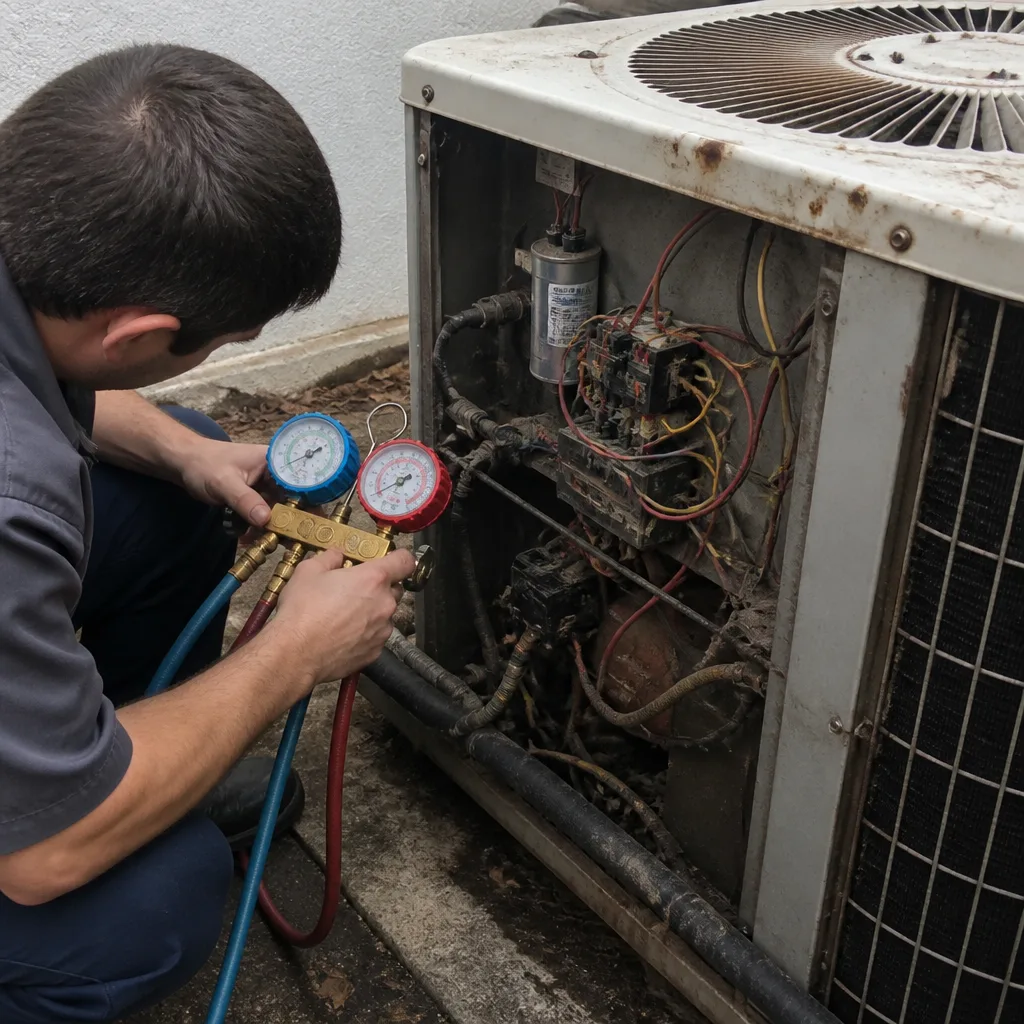 Before
 After
After