
Last updated October 16, 2026
 AC repair
 Furnace & heating
 Heat pumps
 Ductless mini splits
 Carrier
 Trane
Trane Goodman
Seasonal tune-up and full diagnostic on your Carrier, Trane, or Goodman system - readings shown to you before any repair is proposed
Diagnosis first, numbers second - you approve the repair price before a single part goes in.
Get your free estimateHVAC Warning Signs: A Miami Homeowner’s Reference Guide
If your home feels sticky at 74°F, your AC is already failing, just not in the way you’d expect. In Miami, the first thing a struggling system loses is latent cooling capacity: the ability to pull moisture out of the air. The refrigerant is still cold. The unit still runs. But the air never feels right. This guide walks through the warning signs most homeowners miss until the damage is already done, and explains which ones mean call today, which ones mean schedule this week, and what each symptom actually points to inside your system. For The Complete Guide to HVAC in Miami, see our comprehensive overview. We’ve served Miami homes since 2003, and the failures we see follow a pattern, one that has almost nothing to do with temperature and everything to do with what this climate does to a cooling system.
Styles & brands we work with
Quick Answer
The earliest HVAC warning signs in Miami are humidity problems, not temperature problems: sticky air that should be dry, a musty smell that comes and goes, condensation on interior walls or windows, and a system that runs constantly but never makes the house feel right. Other signs include a spike in your FPL bill without a change in usage, short cycling (the system turning on and off in under 10 minutes), ice on the indoor coil, and sounds you haven’t heard before. If you notice any of these, a diagnosis now usually costs less than the repair will after another month of neglect. Use our AC Repair Maintenance Checklist for Miami Homeowners to track symptoms before they worsen.
Table of Contents
- The Humidity Warning Signs: What Miami Breaks First
- How to Read Your FPL Bill for an HVAC Problem Before You Feel One
- Short Cycling: The Sound of a System Killing Itself
- Coil Frost in a 90-Degree City: Why Ice Is an Emergency
- Sounds That Mean Something Is Wrong
- Smells That Should Never Come From Your Vents
- Call Today vs. Schedule This Week: A Triage Reference
- Common Mistakes to Avoid
- When to Call a Professional
- Frequently Asked Questions
- The Bottom Line
The Humidity Warning Signs: What Miami Breaks First
In most of the country, an AC system fails by blowing warm air. In Miami, a system fails by blowing cool air that’s still wet. That distinction matters because the early stage of failure is quiet, comfortable in temperature, and easy to ignore for months. The compressor is still producing cold refrigerant. The blower is still moving air. What’s gone is the system’s ability to remove enough moisture from that air, and the shift happens slowly enough that many homeowners don’t connect the dots until mold appears or the compressor gives out.
Here’s the technical explanation in plain English. An air conditioner removes humidity by passing warm indoor air over a cold evaporator coil. Moisture condenses on the coil, drips into a drain pan, and leaves through a condensate line. That process only works when the coil is cold enough, the airflow is strong enough, and the system runs long enough. Any disruption, a refrigerant charge that’s drifted low, a dirty coil, an undersized duct run, or a blower motor that’s losing speed, reduces how much water gets pulled from the air. The air still feels cool. It just never feels dry.
In our experience across Miami, these are the signs homeowners mention after the fact, once they know what to look for:
- Sticky surfaces at 74°F or below. If your skin feels damp indoors when the thermostat reads cool, the system is not removing moisture. Temperature is fine. Latent cooling is not.
- A musty odor that comes and goes. This is often the first sign of moisture accumulating where it shouldn’t: inside ductwork, around the air handler, or in the condensate pan. It is not the smell of a dirty filter. It is the smell of standing water.
- Condensation on interior walls, windows, or supply registers. Interior wall sweating in Miami means indoor humidity is running above about 60%. Well-sealed, properly cooled homes don’t sweat from the inside.
- Doors or cabinet fronts that stick in summer. Wood absorbs moisture and swells. If interior doors that fit fine in January stick in August, the indoor humidity is too high.
- A system that runs almost constantly but the house never feels crisp. This is the classic signature of an AC that’s fighting below-optimal capacity. It cools, but slowly, and it’s not moving the humidity needle.
One important distinction: humidity problems can come from the equipment, the ductwork, or the house itself. A technician should check all three before quoting a repair. A leaky return duct in an attic can pull in Miami’s 80%-humidity outdoor air and overwhelm even a healthy system. An oversized system, common in older Miami homes that were built with less insulation and later upgraded, cools the air so fast it never runs long enough to dehumidify properly. The symptom is the same, sticky air. The fix is completely different. That’s the core of AC repair in Miami: finding which failure produced the symptom, not just treating the symptom.
When humidity symptoms are accompanied by water around the indoor unit, a clogged condensate drain is the likely culprit, and it can soak ceilings and drywall within days. That’s a same-week call at the latest.
How to Read Your FPL Bill for an HVAC Problem Before You Feel One
The earliest HVAC warning sign in Miami isn’t audible or visible. It’s your FPL bill. Long before a compressor fails, it starts drawing more power for the same amount of cooling. The pattern is consistent, and if you learn to read it, you can catch a failing system 60 to 90 days before the unit quits.
Here’s the pattern that precedes most compressor failures we encounter. You’ll see a month-over-month or year-over-year increase in kilowatt-hours, not rate-driven but usage-driven, at the start or peak of a hot season. The house hasn’t changed. The thermostat setting hasn’t changed. The number of people in the home hasn’t changed. But daily usage climbs: 10%, 15%, 20% above the same period last year. That’s the compressor working harder and longer to deliver the same cooling, and the cause is usually one of three things: a gradual refrigerant loss from a slow leak, a failing capacitor that no longer gives the motor the start it needs, or condenser coils that have gotten so dirty they can’t shed heat.
FPL provides daily and hourly usage data through its online portal. Here’s how to read it as an HVAC diagnostic tool:
- Pull your billing history for the last 12 months. Note the kWh used per day for each billing cycle.
- Compare the same month year over year. July this year versus July last year. Miami temperatures vary year to year, so factor in whether this summer was actually hotter. A 10% usage increase on a month with roughly the same cooling-degree-days is a signal.
- Look at the usage curve within a single day. If the system runs a normal cycle, you’ll see predictable peaks and valleys. If the compressor is struggling, runtimes lengthen and the valleys narrow because the unit kicks back on sooner.
- Watch for a sudden sustained tick upward. A failing start capacitor can add noticeable draw for weeks before the compressor finally refuses to start one sweltering afternoon.
The business-level point is simple. A compressor replacement in Miami usually runs between $2,800 and $5,500 depending on the unit’s tonnage, brand, and the refrigerant it uses. A diagnostic visit and a small repair, a capacitor, a contactor, a refrigerant top-up and leak seal, landed well before the failure, usually costs a fraction of that. The FPL bill is frequently the first clue that the window for a cheap fix is closing.
One caveat. Higher humidity alone (a wetter than normal Miami summer) can also increase usage because the system runs longer to dehumidify even if it’s healthy. That’s why the year-over-year comparison matters more than any single bill. Don’t panic over one higher month. Do investigate a trend.
Short Cycling: The Sound of a System Killing Itself
Short cycling is an HVAC term for a system that starts, runs a few minutes, shuts off, and starts again too soon after. The industry benchmark is cycle times under 10 minutes, repeated over the course of an hour. In Miami, short cycling is deadlier than it is in most places, because every start cycle pulls a large electrical load and generates heat in the compressor windings. The compressor has to shed that heat before it can safely run again. When a system short cycles, the heat never fully dissipates before the next start. In a 90°F Miami afternoon, in a condenser sitting on a hot concrete pad, that heat compounds, and the service life of the compressor shrinks.
You’ll hear it before you see it. The condenser outside kicks on with a thump, runs maybe 4 or 5 minutes, shuts off, and within another few minutes kicks on again. Inside, you’ll notice temperature swings because the system isn’t running long enough to cool the house evenly. Parts of the house never quite reach the thermostat setting, especially rooms on the west side that get afternoon sun. This failure pattern is common in Coral Gables homes with original ductwork, and in Hialeah and Westchester homes where the thermostat sits in a central hallway that cools faster than the surrounding rooms.
The causes of short cycling break into two groups, and the repair cost is very different between them:
- Oversized equipment. If the system was installed too large for the home’s cooling load, it satisfies the thermostat in minutes and shuts off. This is an installation problem, not a breakdown, and the real fix is replacing the unit with a properly load-calculated system. Short cycling from oversizing was common in Miami’s building boom years, when installers routinely added margin “just in case.”
- Failing controls or safety limits. A faulty thermostat, a failing run capacitor, a clogged filter that trips the high-limit, or a low-refrigerant condition that trips the low-pressure switch. These are repairable for $120 to $450 in most cases, and the earlier they’re caught, the less strain has been put on the compressor.
Here’s a simple way to distinguish the two at home. Turn the thermostat down 3°F below the current room temperature. If the system runs long and steadily and cools the house a couple of degrees, it’s probably not oversized. If it still shuts off in under 10 minutes and the house hasn’t really changed, you’re likely looking at an oversized unit or a control problem. Either way, the right technician will diagnose it with pressure and temperature measurements, not guesswork.
What all of these paths share is urgent timing. If your system is short cycling and you ignore it, the compressor gets progressively hotter until it seizes or its windings burn out. The day that happens is usually a day Miami has decided to be 94°F with 78% humidity. And that is, in our experience, how the majority of emergency compressor failures on systems we see happened: the short cycling warning was present for weeks, even months, before the big failure.
Coil Frost in a 90-Degree City: Why Ice Is an Emergency
Seeing ice on your AC system in Miami feels counterintuitive, which is exactly why homeowners overlook it. A coil with frost or a pipe with ice on a hot day doesn’t mean the system is “working extra hard.” It means something is wrong inside the refrigeration circuit or the airflow path, and the ice is the system freezing itself into failure. The cause is almost always one of two things: low refrigerant, or airflow that’s been choked off.
Low refrigerant is the more dangerous of the two for a simple reason. An air conditioner doesn’t consume refrigerant the way a car consumes oil. It is a sealed system. If the charge is low, it leaked somewhere. The leak only grows. As the refrigerant level drops, the pressure inside the evaporator coil drops, which makes the coil temperature drop below freezing. Moisture from the indoor air freezes on the coil, not because the system is performing brilliantly, but because it’s starving. The ice insulates the coil further, airflow drops more, and the coil freezes solid. When the ice finally melts, often because the system overheats or is manually switched off, the water can overwhelm the drain pan and damage ceilings or drywall.
Airflow problems create the same ice through a different path. A filter that’s been left for months, a blower motor that’s losing RPMs, or ductwork that’s collapsed or kinked reduces air movement across the coil. The coil gets too cold, and the same freeze-up happens.
Here’s what to do if you find frost or ice on your indoor unit, on the copper lines at the condenser, or at the outside connections:
- Turn the system to FAN ON. This pushes air over the frozen coil and helps melt the ice faster without cooling the house.
- Do not chip at the ice. The coil fins are thin aluminum. Chipping bends them and turns a repairable problem into a coil replacement.
- Check your filter. If it’s visibly clogged, that may be the entire story. Change it. If the filter is clean and the coil still iced, the culprit is almost certainly low refrigerant or a failing blower.
- Call a technician. This is not a watch-and-wait situation. A frozen coil in Miami means the system is down, and you’re losing the ability to control both temperature and humidity.
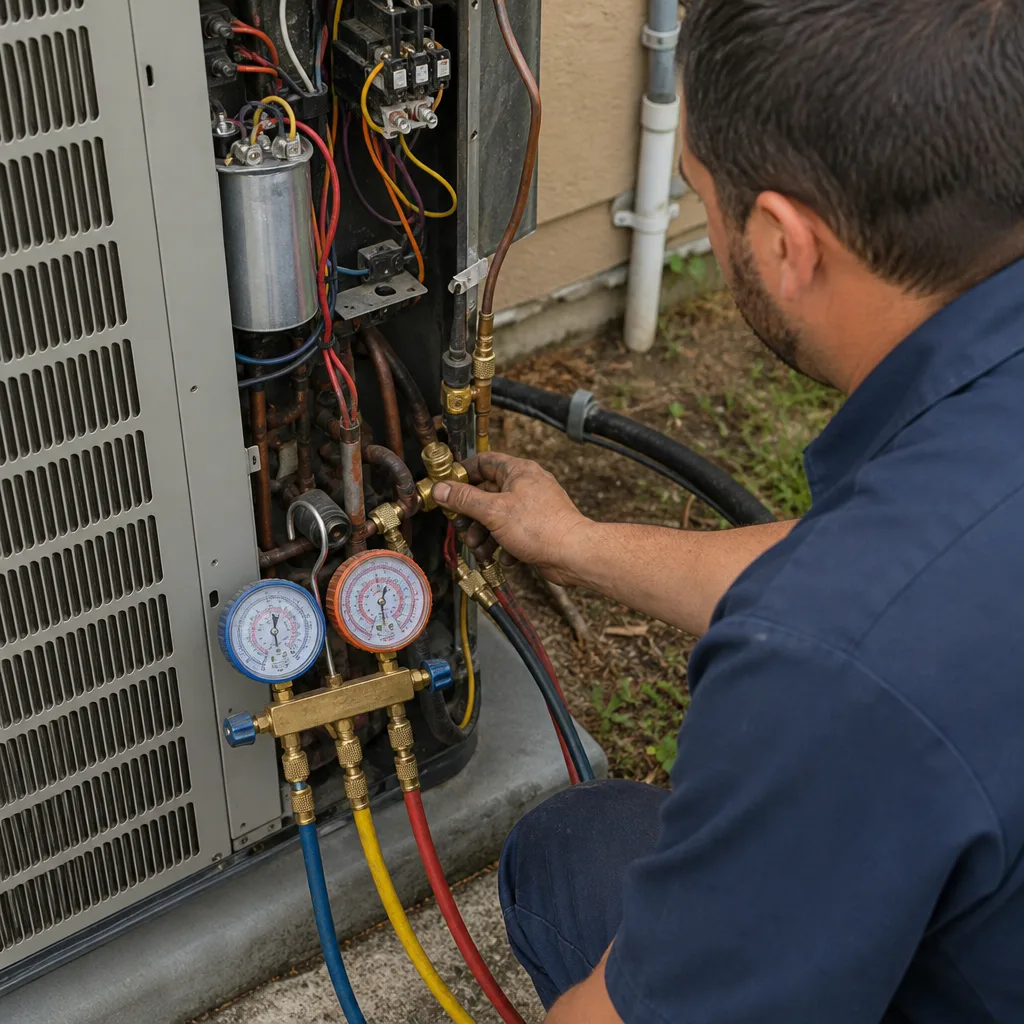
If the system is a Rheem, York, or Daikin unit, the underlying diagnosis follows the same process, pressure and temperature checks at the service valves, superheat and subcooling measurements, and a leak search if the charge is low. The brand doesn’t change the physics. What changes is part availability and access to the right service documentation, which is why our technicians are trained across nine major residential brands.
Sounds That Mean Something Is Wrong
Every AC makes some noise. The hum of the compressor, the whoosh of air from the registers, the occasional click of a relay. But certain sounds aren’t character. They’re language. A technician who’s heard enough systems can often diagnose the general problem area from a phone video, and homeowners who learn to distinguish normal from abnormal sounds catch failures before they cascade.
Here are the sounds most likely to indicate a real problem in a Miami HVAC system:
- Hissing or bubbling. A hiss from the indoor coil or the refrigeration lines, especially accompanied by reduced cooling, points to refrigerant escaping the system. Bubbling can be gas moving through a contaminated or low system. This is the sound of a sealed system losing its charge.
- Grinding. In the outdoor unit, grinding usually means a failing compressor or a failing condenser fan motor bearing. In the indoor air handler, grinding often means a blower motor on its way out. Both need prompt attention because they get worse, never better.
- Squealing. A high-pitched squeal, especially on startup, often points to a failing fan belt on older systems, or a motor bearing that’s dry and dragging. Without intervention, the motor eventually locks and the system stops.
- Loud buzzing or chattering. A buzzing contactor outside is a standard electrical sound when it’s working, but a loud, continuous buzz that doesn’t end with the compressor running is a contactor or relay that’s arcing and needs replacement.
- Popping. In ductwork, popping is usually thermal expansion and contraction of metal duct, not a malfunction. If the popping is consistent and regular, it can mean the ductwork is undersized and fighting the system’s static pressure, which pulls more power and ages the blower.
One sound worth taking seriously in Miami’s humid summers: the audible drip. A properly designed condensate line drains quietly. If you can hear water dripping inside a wall or from a ceiling cavity, that’s water where it shouldn’t be. It’s not an HVAC system warning sound in the conventional sense, but it’s one of the loudest signals we get called about after the drywall is already stained.
If you’re not in a position to call right away, record a short video with audio of the sound and send it to the technician on the phone. A good one can often tell you in seconds whether this is a priority. And a live person answering the phone at Cold Harbour Heating and Air Miami home can help you talk through the symptom before you’re quoted anything.
Smells That Should Never Come From Your Vents
Our sense of smell gives us early HVAC warnings if we trust it. Miami’s heat and humidity push every odor in the system to the surface, which is why certain smells are much more common here than in drier climates. The distinction worth knowing is between the “dirty sock” smell, the electrical smell, the burning smell, and the pungent chemical smell. Each points to a different problem, and two of them are true emergencies.
The dirty sock smell, musty and damp, is the one most Miami homeowners will encounter at some point. It comes from microbial growth on the evaporator coil or inside the ducts. It happens in Miami because the coil is wet for long stretches of every day, 8 or more months a year, and if organic dust from the return air accumulates on that wet coil, it becomes a food source. The smell is strongest when the system starts running after being off. It is not, despite the hopeful interpretation, just “the way the AC smells in summer.” It means the system’s dehumidification is compromised, or the condensate isn’t draining fully, and it will worsen until addressed.
The electrical smell, acrid and sharp like burnt plastic or ozone, is what we tell homeowners to treat as an emergency. It means a motor is overheating, a capacitor is venting, or wiring is arcing somewhere in the system. If you smell it, shut the system off at the thermostat and call a technician. This smell won’t resolve itself, and leaving the system running risks a fire.
The burning smell on the first startup of the season, or after the system has sat for a while, is usually settled dust burning off heat strips in a heat pump or electric furnace. It should fade within a few minutes. If it persists beyond 10-15 minutes, if it’s coming from the outdoor unit, or if smoke is visible, shut the system down and call a professional immediately.
A pungent, almost sweet chemical smell can be refrigerant. Refrigerant itself is largely odorless in small quantities, but additives and compressor oil can carry a distinctive chemical odor when the system leaks under pressure. If you smell it near the indoor unit, ventilation is the priority. In a closed Miami house, concentrated refrigerant can displace oxygen. Open windows and call a technician, and if anyone in the home feels dizzy or lightheaded, step outside and seek medical help.
Call Today vs. Schedule This Week: A Triage Reference
Not every warning sign is an emergency, but Miami’s heat and humidity compress the timeline for all of them. What might be a next-week issue in a drier, cooler climate becomes a next-36-hours issue here, because the system is also managing dew point, condensation, and mold risk. Our Seasonal HVAC Care for Miami: Year-Round Homeowner’s Guide explains how to stay ahead of these accelerated timelines. Here’s how we break it down for homeowners:
Call today, ideally right now:
- Electrical or burning smell from the vents or the outdoor unit
- Ice on the indoor coil or the copper refrigerant lines
- Water actively leaking from the indoor unit into the home
- The system trips the circuit breaker more than once
- The compressor won’t start and the condenser is humming loudly
- The home won’t cool below 82°F during a Miami heat advisory
Schedule within the week:
- Sticky, humid air that persists even when the house is cool
- A gradual FPL usage increase without a matching change in weather
- Short cycling you’ve noticed for a few weeks
- Intermittent musty smell from the vents
- Slight rattling or humming that comes and goes
- A drain pan that’s damp but not overflowing
Here’s the rationale for the split. The first group includes failures that can cause property damage (water), personal danger (electrical), or complete system death within hours (iced coil, seized compressor). The second group includes failures that are progressing, but slowly enough that a same-week appointment catches them before the damage compounds. The single exception we’d make is in the second group: if anyone in the home has a respiratory condition, mold from a humidity problem is a genuine health risk, not a comfort annoyance, and we’d move that up to a today call.
One more consideration for Miami specifically. Coastal homes in areas like Key Biscayne, Surfside, and Bal Harbour see accelerated condenser coil corrosion from salt air. If you live within a mile or two of the coast, any warning sign is worth taking more seriously than the same symptom in Kendall or Doral, because the outdoor unit’s fins and the electrical connections are already degrading faster. Salt corrosion is the quiet multiplier in Miami’s HVAC failure rates.
Common Mistakes to Avoid
- Turning the thermostat down to 68°F to fix a humidity problem. Lowering the set point does not make a dehumidification problem go away. It makes the system run longer and drives your bill up without fixing the core issue. We’ve seen homeowners run 68°F homes that felt worse than a properly dehumidified 76°F home.
- Ignoring frost on the coil because it’s “at least cold.” Ice is not the system working. It’s the system failing in a way that actively causes more damage the longer it runs.
- Switching between Celsius and Fahrenheit to diagnose problems. If the thermostat reads differently than your comfort suggests, the problem is a miscalibrated sensor, not the units. Don’t process it as a display error. A thermostat that’s 3°F off makes the entire system run on the wrong assumptions.
- Adding refrigerant without finding and fixing the leak. Refrigerant is a closed system. If a technician offers a top-up without locating the leak, you’re paying for a temporary fix and guaranteeing another top-up later. A proper repair is leak detection, repair, and recharge, not a rolling refill.
- Covering the outdoor condenser with a tarp during the rainy season. This traps humidity against the coil and accelerates corrosion. Condensers are built to be outdoors and vent moisture. Covering them does more harm than good.
- Closing registers in unused rooms to save money. Modern blowers are sized for the duct system’s full airflow. Closing registers increases static pressure, which strains the blower and can freeze the coil. If certain rooms are consistently too warm, that’s a duct or insulation issue, not a register management issue.
When to Call a Professional
You should call a professional for any of the symptoms in the Call Today column, and for any humidity symptom that hasn’t resolved within a few days of changing the filter. The honest rule of thumb is this: if you’ve checked what you can safely check (filter, thermostat, breaker, drain pan) and the symptom persists, the next step in the diagnostic process involves refrigerant gauges, electrical meters, and sometimes opening the air handler, and those are not DIY steps. Cold Harbour Heating and Air Miami offers free estimates in Miami, call (850) 810-1910 and a licensed technician will walk you through the symptoms, give you a written price before any work begins, and show up in the window we promise. For those considering a system replacement rather than another repair, see our guide to AC installation in Miami for honest cost ranges and what the process actually involves.
Frequently Asked Questions
Your system has lost its latent cooling capacity: the ability to remove moisture from the air. The most common causes are a refrigerant charge that’s drifted low, a dirty coil, failing blower speed, or ductwork that’s pulling in humid outdoor air from an attic leak. In Miami’s climate, this is the earliest and most often missed warning sign of HVAC failure, and it usually precedes the system’s eventual breakdown by weeks or months. Call us at (850) 810-1910 for a exact diagnosis and a written quote on whatever we find.
Most minor repairs, things like a capacitor, contactor, or thermostat replacement, run $120 to $450 in Miami. Mid-level repairs, like a blower motor or an evaporator coil cleaning and service, run $400 to $1,200. Compressor replacement on a typical Miami home’s system runs $2,800 to $5,500 depending on tonnage, brand, and required refrigerant. The best way to know your exact price is to call (850) 810-1910, we’ll give you a written quote before any work starts.
If the repair costs more than about 40% of the cost of a new system and your unit is over 10 years old, replacement is usually the better long-term decision in Miami’s climate. A 12-year-old system that needs a $2,000 repair is a system that’s likely to need another $2,000 repair within two years. But the honest answer depends on the unit’s condition, your budget, and how long you plan to stay in the home, so we always present both paths with written numbers for each.
Yes. Cold Harbour Heating and Air Miami has a live person answering the phone 24 hours a day, 7 days a week. If your system is down and the symptom falls into the Call Today category, we’ll schedule a same-day appointment in most Miami neighborhoods and give you a firm arrival window when you call (850) 810-1910.
That’s short cycling, and in Miami it accelerates compressor wear faster than almost anywhere in the country because the compressor never gets a chance to dissipate start-up heat before the next cycle begins. The cause is one of two things: an oversized system installed without proper load calculation, or a failing control component like a thermostat, capacitor, or pressure switch. The first step is to confirm the cycle times. Then call us at (850) 810-1910 for a diagnosis.
Yes, depending on the cause. If the system is still mechanically healthy, the fix can be as simple as adjusting blower speed, repairing duct leaks in the attic, or addressing a condensate drain issue. If the unit is oversized, the most effective permanent fix is replacement with a properly sized system, but even then a whole-home dehumidifier can buy time and comfort. A knowledgeable technician should show you the underlying data, not just sell a piece of equipment. Call (850) 810-1910 for a no-pressure evaluation.
The Bottom Line
The shortest version of this guide is simple: in Miami, watch the humidity first. The system that’s quietly losing its ability to dry the air is the system that’s months from an expensive failure. Your FPL bill, the cycle times you can count from the living room, ice on a coil in summer, and smells that don’t belong in your vents, each of these is a warning signal that you can act on before the heat does. Cold Harbour Heating and Air Miami has been serving Miami since 2003, and every repair is backed by our 365-Day Done Right Promise: a written guarantee that if the repair fails within a year, we come back and make it right at no charge. You can also read more about our furnace repair in Miami services. Call (850) 810-1910 for a free estimate and a written price before any work begins.
Written by Victor Mancini, Owner at Cold Harbour Heating and Air Miami, serving Miami since 2003. Browse more guides & resources from our team.
See the difference
 Before
 After
After Before
 After
After Before
 After
After